GPS Train Speed Test
Measure your train speed accurately using GPS technology. Free online tool with no installation required that works on all devices.
Start GPS Speed TestHow GPS Measures Speed
The Global Positioning System (GPS) is a satellite-based navigation system that provides precise positioning and timing information to receivers anywhere on Earth. When it comes to measuring speed, GPS operates on a beautifully simple principle: by tracking changes in your position over time, it can calculate how fast you are moving. This is fundamentally different from how traditional speedometers work, and understanding this difference is key to appreciating why GPS is such an effective tool for measuring train speed.
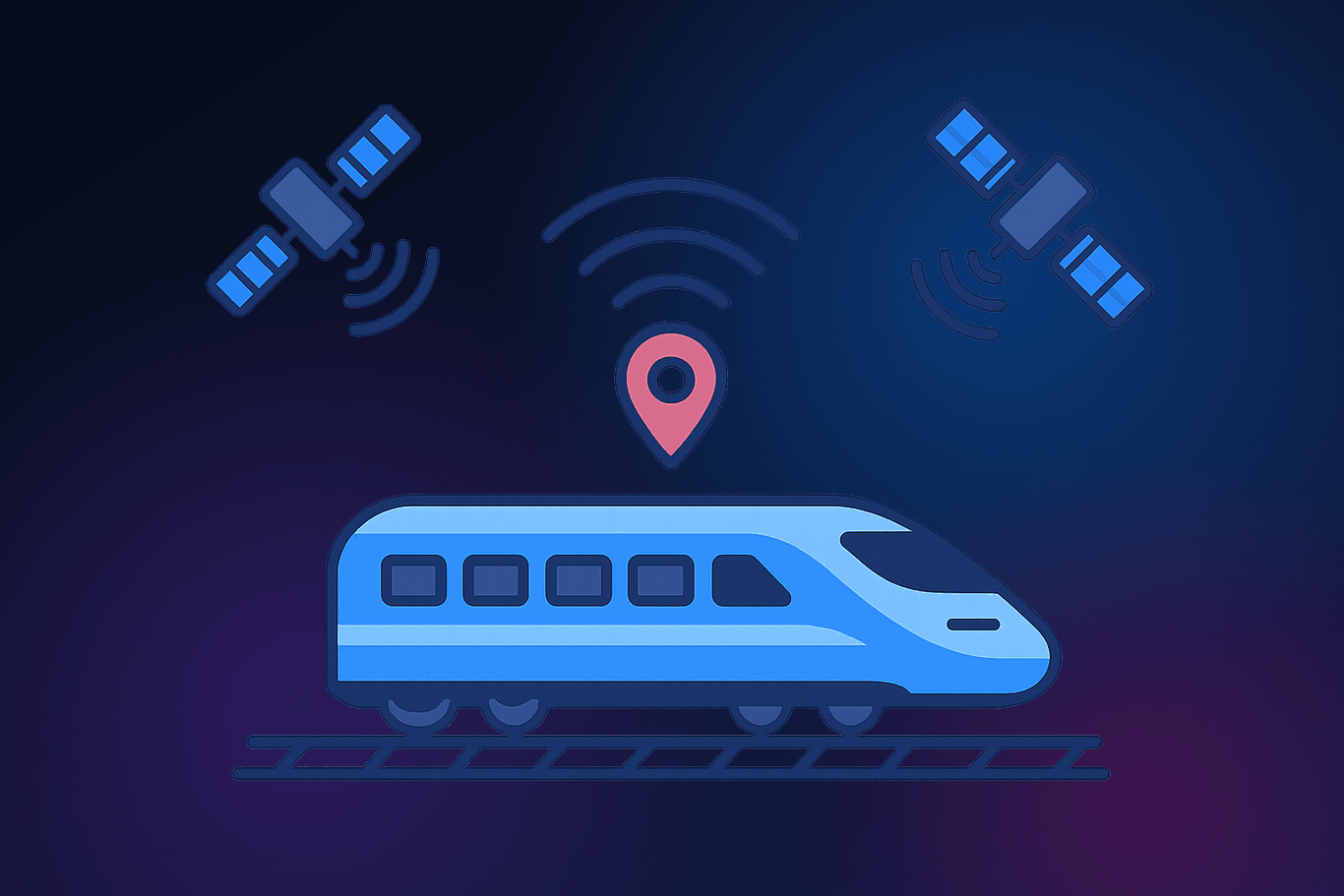
A GPS receiver — whether in a dedicated device or built into your smartphone — communicates with a constellation of at least 24 satellites orbiting the Earth at an altitude of approximately 20,200 kilometers. Each satellite continuously broadcasts signals containing its precise position and the exact time the signal was transmitted. Your device receives these signals from multiple satellites simultaneously and uses the time differences to calculate its own position through a process called trilateration. Modern GPS receivers can determine your position with an accuracy of 3-5 meters under good conditions, updating this position multiple times per second.
Speed calculation using GPS is derived from two fundamental quantities: distance and time. When your device records its position at time T1 and then again at time T2, it can calculate the straight-line distance between these two points. Dividing this distance by the time interval (T2 minus T1) gives your average speed during that interval. The GPS train speed test performs this calculation continuously, typically once every second, providing a real-time speed reading that updates as you travel. This method of speed measurement is known as "position-derived speed" and is considered highly accurate for most practical applications.
Why GPS Is Perfect for Measuring Train Speed
GPS technology offers several unique advantages that make it particularly well-suited for measuring train speed. The most significant advantage is that GPS determines speed based on your absolute position on Earth, independent of any mechanical connection to the train. Traditional train speedometers work by measuring the rotational speed of the train's wheels through a mechanical or electronic sensor. This approach is susceptible to several sources of error: wheel slip during acceleration or braking can cause momentary inaccuracies, wheel wear gradually changes the effective wheel diameter and introduces systematic errors, and different wheelsets on the same train may have slightly different diameters due to uneven wear.
GPS eliminates all of these mechanical error sources entirely. Whether the wheels are slipping, worn, or unevenly sized, the GPS receiver simply tracks your position and calculates speed based on how far you have moved through space. This makes GPS speed measurement more reliable and consistent than wheel-based methods, especially under varying track and weather conditions.
Another advantage of GPS for train speed measurement is its independence from the train's systems. You do not need access to the locomotive's instruments, you do not need cooperation from the train operator, and you do not need any specialized equipment installed on the train. A simple smartphone with GPS capability is all that is needed. This accessibility makes GPS speed measurement available to anyone — passengers, researchers, enthusiasts, and journalists — without any institutional barriers or technical requirements.
GPS Accuracy Factors for Trains
While GPS is a remarkably accurate technology, several factors can affect the precision of speed measurements taken on trains. Understanding these factors helps you interpret your results more accurately and take steps to minimize their impact.
Signal Obstruction
The most significant factor affecting GPS accuracy on trains is signal obstruction. GPS signals are relatively weak by the time they reach the Earth's surface, and they can be blocked or attenuated by various obstacles. Tunnels are the most complete form of obstruction — GPS signals cannot penetrate the rock and concrete of a tunnel, causing the receiver to lose all satellite contact. Underground railway sections present the same challenge. Even on surface-level tracks, deep cuttings, dense tree cover, and tall buildings alongside the railway can partially or fully block GPS signals. When your GPS train speed test encounters these obstructions, it will temporarily lose the ability to calculate speed until signals are reacquired.
Multipath Effects
In urban environments, GPS signals can bounce off building surfaces before reaching your device's receiver. This phenomenon, known as multipath interference, can introduce positioning errors that affect speed calculations. When a signal reflects off a building, it travels a longer path than the direct line-of-sight signal, causing the receiver to miscalculate its position. Modern GPS receivers include multipath mitigation techniques, but some residual error may still occur in dense urban areas. For the most accurate GPS train speed test results, open suburban or rural sections of the route typically provide better signal quality than dense city centers.
Atmospheric Conditions
The Earth's atmosphere can also affect GPS signal propagation. The ionosphere, a layer of charged particles at high altitude, can delay GPS signals as they pass through, introducing timing errors that translate to positioning errors. The troposphere, the lowest layer of the atmosphere where weather occurs, can similarly affect signal speed. GPS receivers use mathematical models to compensate for these atmospheric effects, and dual-frequency receivers (found in some high-end smartphones and dedicated GPS devices) can measure and correct for ionospheric delays more precisely. Under normal weather conditions, atmospheric effects on GPS train speed test accuracy are typically minor — usually less than a few kilometers per hour.
Device Hardware Quality
Not all GPS receivers are created equal. The quality of the GPS chip in your device significantly affects measurement accuracy. High-end smartphones typically include more sensitive GPS receivers with better signal processing capabilities than budget devices. Dedicated GPS devices designed for navigation or surveying often provide even better performance than smartphone GPS. However, for the purposes of a GPS train speed test, the difference between a modern mid-range smartphone and a high-end device is usually small enough to be insignificant for most users. The environmental factors described above typically have a much larger impact on accuracy than hardware differences between modern devices.
How to Get the Best Results from Your GPS Train Speed Test
To maximize the accuracy of your GPS train speed test, follow these proven strategies. First and most importantly, position your phone near a window. The metal body of a train significantly attenuates GPS signals, but glass windows allow them to pass through with much less attenuation. If possible, choose a seat on the side of the train that has a clearer view of the sky, as this can make a measurable difference in signal quality and positioning accuracy.
Second, ensure that GPS is enabled on your device before you board the train. Some devices take 30 seconds to several minutes to acquire a GPS lock, particularly if they have not used GPS recently. By enabling GPS early, you give your device time to establish a solid connection with satellites before you start moving. Third, keep your phone's screen on during the GPS train speed test. Some operating systems reduce GPS polling frequency when the screen is off to conserve battery power. While the GPS continues to function, slower polling can result in less responsive speed readings and lower accuracy.
Fourth, minimize other applications that use GPS during your test. While modern operating systems are generally effective at managing GPS resources, having multiple location-aware applications running simultaneously can occasionally cause conflicts or reduce the frequency of GPS updates. Fifth, start your GPS train speed test in an area with good signal reception. If you know your route includes tunnels, begin the test before entering the tunnel so that the GPS has established a strong lock. After exiting the tunnel, the GPS will reacquire signals more quickly if it already has satellite data from before the obstruction. Finally, for the most comprehensive results, run the GPS train speed test for the entire duration of your journey. This captures the full range of speed variations, including acceleration from stations, cruising speed on open sections, and deceleration approaching stops.
Putting all of this into practice is simplest with the train speed test online on this site, since nothing has to be downloaded and no account is required. Open it before you board, grant location permission, and the reading will be ready by the time the train leaves the platform.
GPS Speed vs. Train Speedometer: Which Is More Accurate?
A common question among railway enthusiasts is whether a GPS-based speed measurement is more or less accurate than the speedometer displayed in the locomotive cab. The answer depends on the context. The train's official speedometer, connected to the wheel axle through calibrated sensors, provides the speed that the train operator relies on for safe operation. This system is calibrated to account for the specific wheel diameter of that locomotive and is regularly maintained to ensure accuracy. For regulatory and safety purposes, this is the authoritative speed measurement.
However, GPS speed measurement offers advantages in certain scenarios. Because GPS measures speed based on position changes rather than wheel rotation, it is not affected by wheel slip during acceleration or braking — a situation where mechanical speedometers can momentarily display incorrect values. GPS also provides a consistent measurement methodology across all trains and routes, whereas mechanical speedometer accuracy can vary between different locomotives and maintenance schedules. For casual users, researchers, and enthusiasts, a well-executed GPS train speed test provides results that are sufficiently accurate for documentation and comparison purposes, typically within 5-10 km/h of the train's actual speed under good conditions.
Understanding GPS Speed Smoothing
Raw GPS data contains inherent noise — small fluctuations in position readings that do not reflect actual movement. If you were to display unfiltered GPS speed data, you would see the speed reading jumping around erratically, even when the train is traveling at a perfectly constant speed. To address this, GPS speed test tools apply smoothing algorithms that filter out these rapid fluctuations and provide a more stable, readable display.
The most common smoothing technique is a moving average, where the displayed speed is calculated as the average of the last several GPS readings rather than just the most recent one. This approach effectively filters out short-term noise while still responding quickly to genuine changes in speed. More advanced algorithms, such as Kalman filters, use mathematical models of expected motion to distinguish between GPS noise and actual speed changes. The GPS train speed test on this page uses a carefully tuned smoothing algorithm that balances responsiveness with stability, providing readings that are both accurate and easy to read. The trade-off inherent in all smoothing approaches is that heavier smoothing produces more stable readings but introduces a slight delay in responding to rapid speed changes. For most train speed measurement scenarios, the default smoothing provides an excellent balance.
Frequently Asked Questions
Ready to Measure Train Speed with GPS?
Our GPS-powered speed test is ready to measure your train speed with precision. Start now and get instant results.
Start Speed Test Now